|
About ACTMalaria
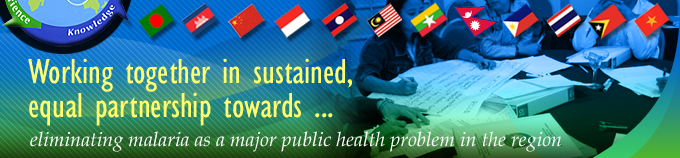
ACTMalaria (Asian Collaborative Training Network for Malaria) is an inter-country training and communication network which includes National Malaria Control Programmes of Bangladesh, Cambodia, PR China, Republic of Indonesia, Lao PDR, Malaysia, Myanmar, Philippines, Thailand, Timor Leste, and Vietnam.
The network aims at 2 major objectives:
- Provide collaborative training for member countries to meet the needs of malaria control in Southeast Asia and Mekong valley;
- Improve communications among member countries on malaria problems affecting common borders.
Our VISION
Working together in sustained, equal partnership towards eliminating malaria as a major public health problem in the region.
Our MISSION
To promote cooperation and collaboration to strengthen capacity building and information exchange for the improvement of the quality and effectiveness of malaria control programme in member countries.
Our GOALS
- Promote and strengthen regional and national technical and management capacities in malaria control in member countries
- Enhance relationship among member countries and partners through continuous knowledge and experience sharing
- Broaden the base of ACTMalaria partnership with organizations and institutions and promote its value and effectiveness for other countries/regions to follow
- To establish an effective, efficient, accountable and professionally managed organization
:: Back to Top
The Birth of ACTMalaria
In recognition of malaria being a disease problem that not only does not recognize international boundaries, but is frequently in association with these borders, the need for collaborative efforts between countries has been recognized. Implemented programmes in neighboring countries are often confounded by cross-border migration of malaria problems to exact an additional burden on the country that is both difficult to predict and manage. From this, it is very clear that forest malaria control needs to incorporate a regional approach if individual country programmes are to be successful. Attention and efforts need to be focused on countries not within national boundaries, but within geographical areas and these efforts need to include training to facilitate a transfer of knowledge, technology, and experience.
The Malaria Division of the Department of Communicable Disease Control, Ministry of Public Health, Thailand, in collaboration with the World Health Organization convened a meeting on Human Relations Development for Malaria Control in November 1996 in Chiangmai, Thailand. In the meeting, national malaria control programme (NMCP) directors from Thailand, Bangladesh, Cambodia, Yunnan province in China, Indonesia, Lao PDR and Vietnam identified national and international training needs and cross-border collaboration. Other participants included representatives of the Faculty of Tropical Medicine, Mahidol University, SEAMEO TROPMED, the College of Public Health, Chulalongkorn University, the Faculty of Medicine, Chiangmai University and partnerships between countries and the Asian Development Bank (ADB), World Bank (WB), the Malaria Consortium/UK and Belgian Aid. WHO provided resource persons from the Office of Health Services and the Division of Control of Tropical Diseases, WHO, Geneva, from the Southeast Asian Regional Office and from the office of the WHO Representative to Thailand. The outcome of the meeting was the creation of an informal network for malaria training at the national and international levels as well as the establishment of an information communication network. The collaborative group was named ACTMalaria (The Asian Collaborative Training Network for Malaria). ACTMalaria was set to cover a geographical region that spans two WHO regions - WPRO and SEARO.
:: Back to Top
Its Metamorphosis
ACTMalaria began as a project involving countries in Southeast Asia and the Greater Mekong Sub-Region . The first coordinating body and secretariat was set in Thailand and primarily consisted of professionals in malaria and/or education who gave their time to the organization on a part-time basis. ACTMalaria quickly grew into an international organization drawing attention to its collaborative approach in solving cross border disease problems. In 1997 ACTMalaria started to produce a newsletter and established its website. In addition, it also began to develop curricula and implement training courses, one of which is the 11 week programme - Management of Malaria Field Operations.
The rapid development of ACTMalaria has resulted in its need for consolidation as well as its establishment as an independent organization. Thus, in February 1998, ACTMalaria carried out a Workshop on Institutional Strengthening with financial supports from the RTG/WHO 1998/1999 fund. The aim was to determine an institutional development and strengthening strategy for the organization. The proposed structures and strategies were endorsed by all its members, i.e. Indonesia, Myanmar, Lao PDR, Vietnam, Thailand, Malaysia, Bangladesh, Yunnan Province of China and Cambodia at a meeting of the membership in May 1998.
The key element in the institutional strengthening plan then was the establishment of a Secretariat in Bangkok, responsible to the rotating Coordinating Country Directorship for administrative, financial and operational implementation in support of the organization. Together with a Technical Coordinator, the team carry outs the activities of ACTMalaria. This was all embodied in the Memorandum of Understanding that was signed in May 1999 in Depansar, Indonesia.
In 2000, ACTMalaria's membership grew from 9 to 11 countries (Bangladesh, Cambodia, PR China, Lao PDR, Indonesia, Myanmar, Malaysia, Thailand and Vietnam) with the inclusion of Philippines and Singapore.
:: Back to Top
ACTMalaria's Present Form
The external evaluation of ACTMalaria in 2000 has called for further strengthening for the organization to be able to respond to heightened expectations from both its members and partners. The needed transformation brought the office of the organization to the Philippines where it was able to obtain legal status as a non-stock, non-profit organization, registered with the Securities and Exchange Commission (SEC) on August 13, 2003.
In the process of institutionalization, the organization was renamed as ACTMalaria Foundation, Incorporated with its new office located at the Ramon Magsaysay Center along Roxas Boulevard in Manila. It also brought out a new set of organizational structure which comprises the functioning body of the organization as defined in its new statement of cooperation drafted by its members in the last EB meeting in 2003 based on SEC approved by-laws and articles of incorporation.
:: Back to Top
Its Future
The medium-term plan of the organization is presented in its Strategy and Workplan 2003-2006 which was developed by its members based on identified operational priorities and needs.
It is expected that the organization will continue to evolve as it adopts to the changing needs and demands of its members and as the health sector develops.
Membership might continue to expand as it sought other Southeast Asian countries who shares cross border disease problems and who supports collaborative action in the identification of problems and solutions.
:: Back to Top
|